
Extractive Companies: Practical Implementation of Regulatory Updates in Line with Liability Levels
For companies working within the extractive sector, their Health, Safety and Environment (HSE) divisions are at the forefront of regulatory compliance relating to the safety and security of their workforces, as well as to the environment.
In order to maintain company compliance, an HSE division should regularly monitor the applicable regulations, including Law No. 32/2009 on Environmental Protection and Management (UU 32/2009). The obligations that apply under Law 32/2009 are usually obligations that have a high priority within the company and which can result in criminal sanctions being imposed upon non-compliant corporations, including criminal sanctions for violations relating to quality standards, waste management and licensing.
Unfortunately, regulatory monitoring, as implemented by HSE divisions, is often associated with its own challenges and difficulties. For example, any manual monitoring of regulations – which is usually completed by inputting a list of regulations and detailing the company's obligations using Microsoft Excel spreadsheets – may result in human errors, as well as being an inefficient allocation of both time and energy.
Moreover, HSE divisions cannot see updates in real-time if they use this method. Also, in addition to obligations that are based on regulations, certain obligations relate to certain permits. Ultimately, a lack of HSE division resources can become a problem during attempts to monitor and keep abreast of updated regulations and the numerous obligations associated with them.
For example, the issuance of the Job Creation Law (UU Ciptaker) has resulted in changes being made to many of the provisions originally set out under Law 32/2009. Indeed, the Ciptaker Law has resulted in the issuance of a new government regulation that introduces changes to the framework of Law 32/2009, namely Government Regulation No. 22/2021 on the Implementation of Environmental Protection and Management (PP 22/2021). This revision has ultimately resulted in the issuance of 180 amended obligations, 228 new obligations and 39 repealed obligations.
Furthermore, PP 22/2021 is the original framework for the issuance of the following regulations:
- Regulation of the Minister of Environment and Forestry Number 4 of 2021 on the List of Businesses and/or Activities Required to Produce Environmental Impact Analyses, 1. Environmental Management Efforts and Environmental Monitoring Efforts or Statements of Environmental Management and Monitoring Ability
- Regulation of the Minister of Environment and Forestry Number 5 of 2021 on 2. Procedures for the Issuance of Technical Approvals and Operational Eligibility Letters Within the Field of Environmental Pollution Control
- Regulation of the Minister of Environment and Forestry Number 6 of 2021 on Procedures and Requirements for the Management of Hazardous and Toxic Waste
- Regulation of the Minister of Environment and Forestry Number 11 of 2021 on Quality Standards for Internal Combustion Engine Emissions
- Regulation of the Minister of Environment and Forestry Number 12 of 2021 on Quality Standards for Lithium Battery Recycling Emissions
- 6. Minister of Environment and Forestry Regulation Number 13 of 2021 on Information Systems for the Continuous Monitoring of Industrial Emissions
The issuance of implementing regulations for PP 22/2021 will result in many new obligations, amended obligations or revoked obligations, and these changes must be complied with by all affected companies.
Moreover, the revision of the Ciptaker Law and its implementing regulations has not yet been concluded and, in November 2021, the Constitutional Court (MK), through the issuance of Decision Number 91/PUU-XVIII/2020, affirmed that the Copyright Act was conditional. The government was thus given two years to fix it and was banned from issuing any new derivative regulations for the time being. This means that for a maximum period of two years commencing November 2021, improvements will be formulated for the framework of the Ciptaker Law.
These improvements will undoubtedly have an impact on various industries, including extractive industries. HSE Divisions will be expected to renew the list of regulations that relate to the relevant companies’ businesses, while at the same time detailing the company's obligations, as set under the relevant new regulations. The high expectations that companies have of their HSE divisions are thus becoming increasingly hard to meet given that all of these jobs often have to be undertaken manually and periodically.
In line with our commitment of over two decades to consistently provide solutions, Hukumonline presents NEX Compliance, an AI-powered Regulatory Compliance System designed to help your team stay one step ahead in managing every compliance obligation.
Stay one step ahead with NEX Compliance by Hukumonline. Designed to streamline regulatory tracking, map legal obligations, and minimize compliance exposure, all within a single AI-powered platform.
How does NEX Compliance help companies face regulatory changes?
Now AI-Powered
Accelerate regulatory research and obligation tracking. Driven by AIlex Hukumonline turns complex regulations into clear, actionable insights in seconds.
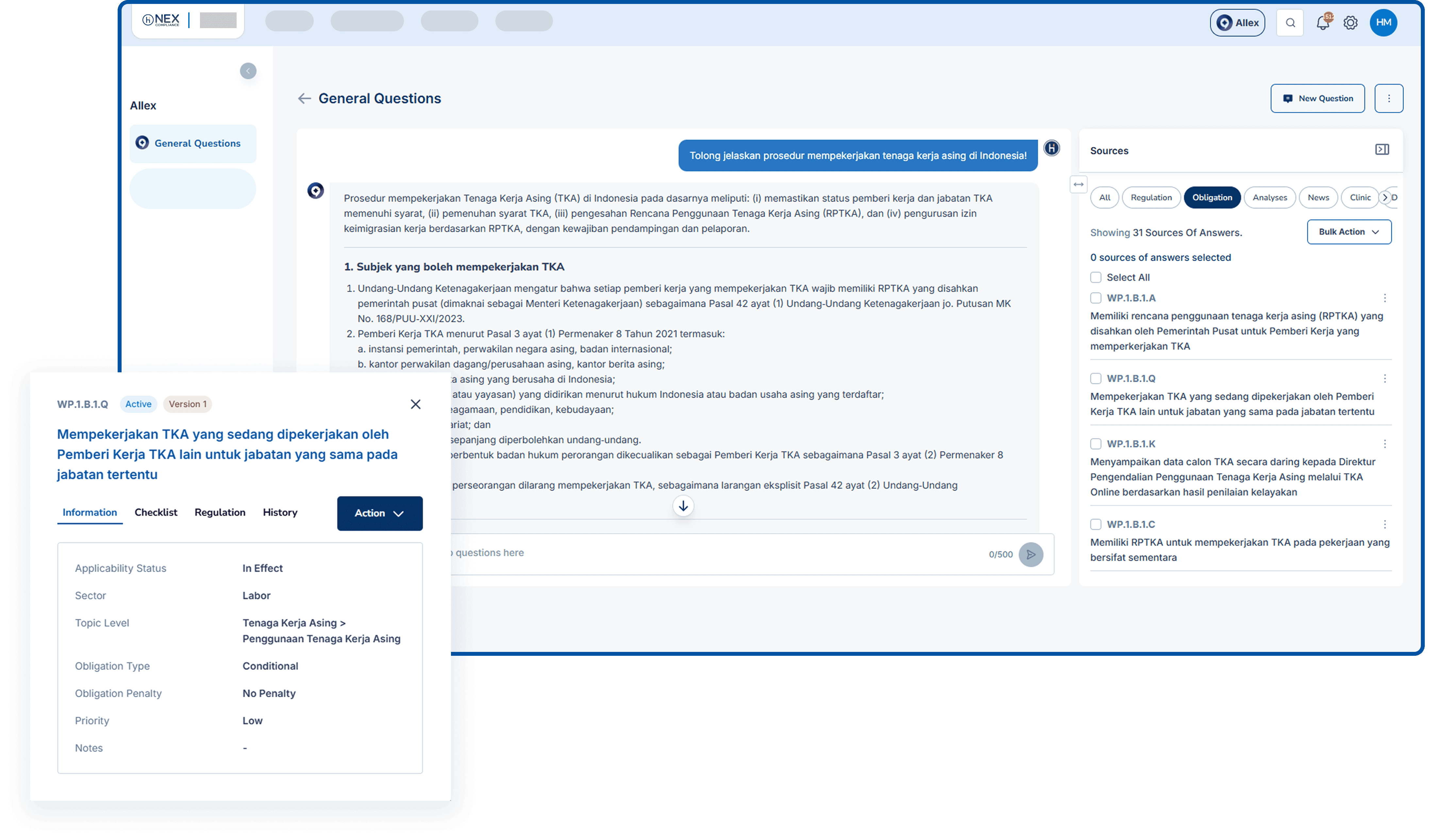
Verified by Industry Expert
Hukumonline's compliance monitoring platform provides content verified by industry experts, ensuring accuracy and relevance for your business.
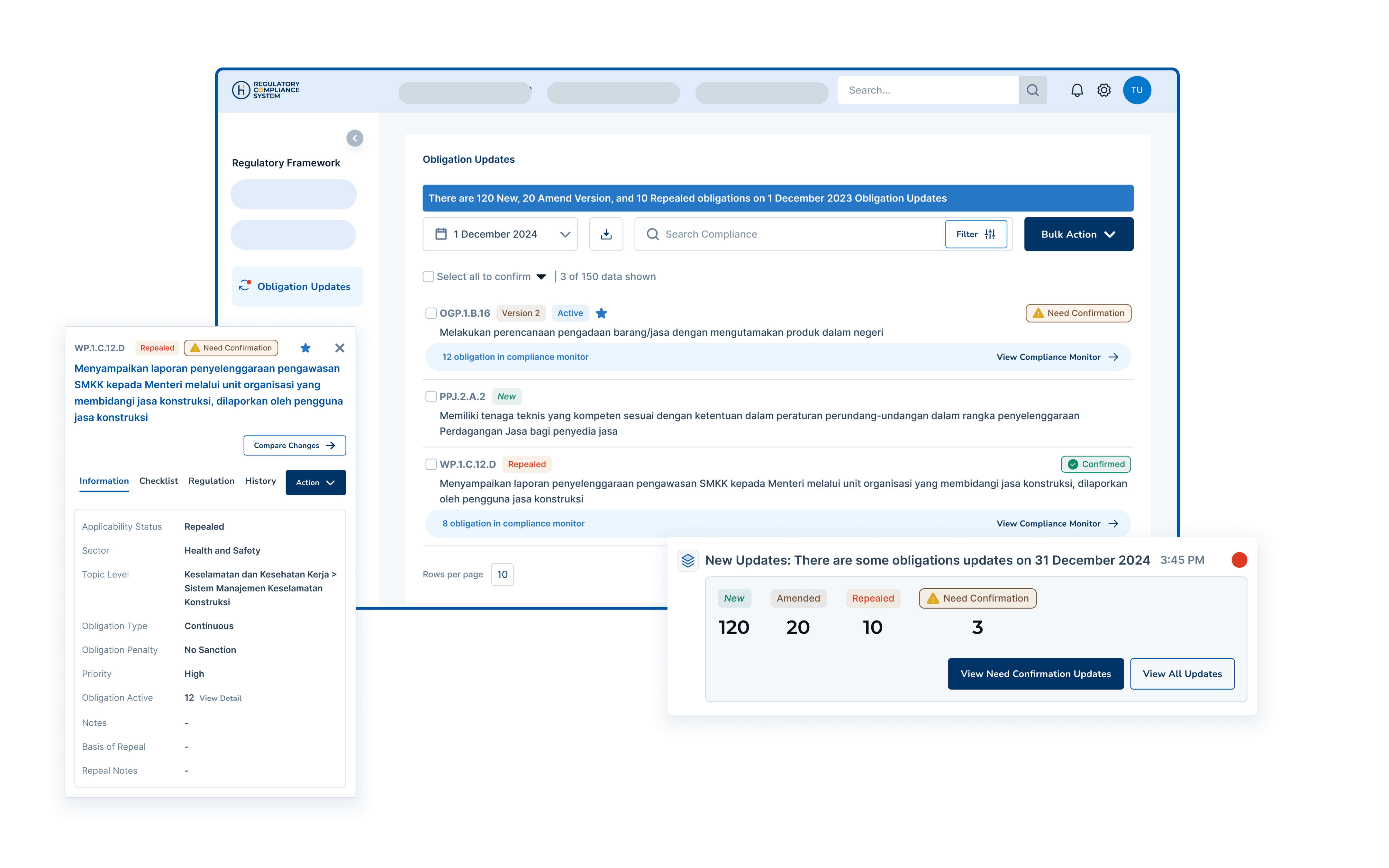
5x Faster and 65% More Efficient
Transform legal obligations into actionable items. Streamline monitoring, elevate process efficiency, and drive operational compliance.
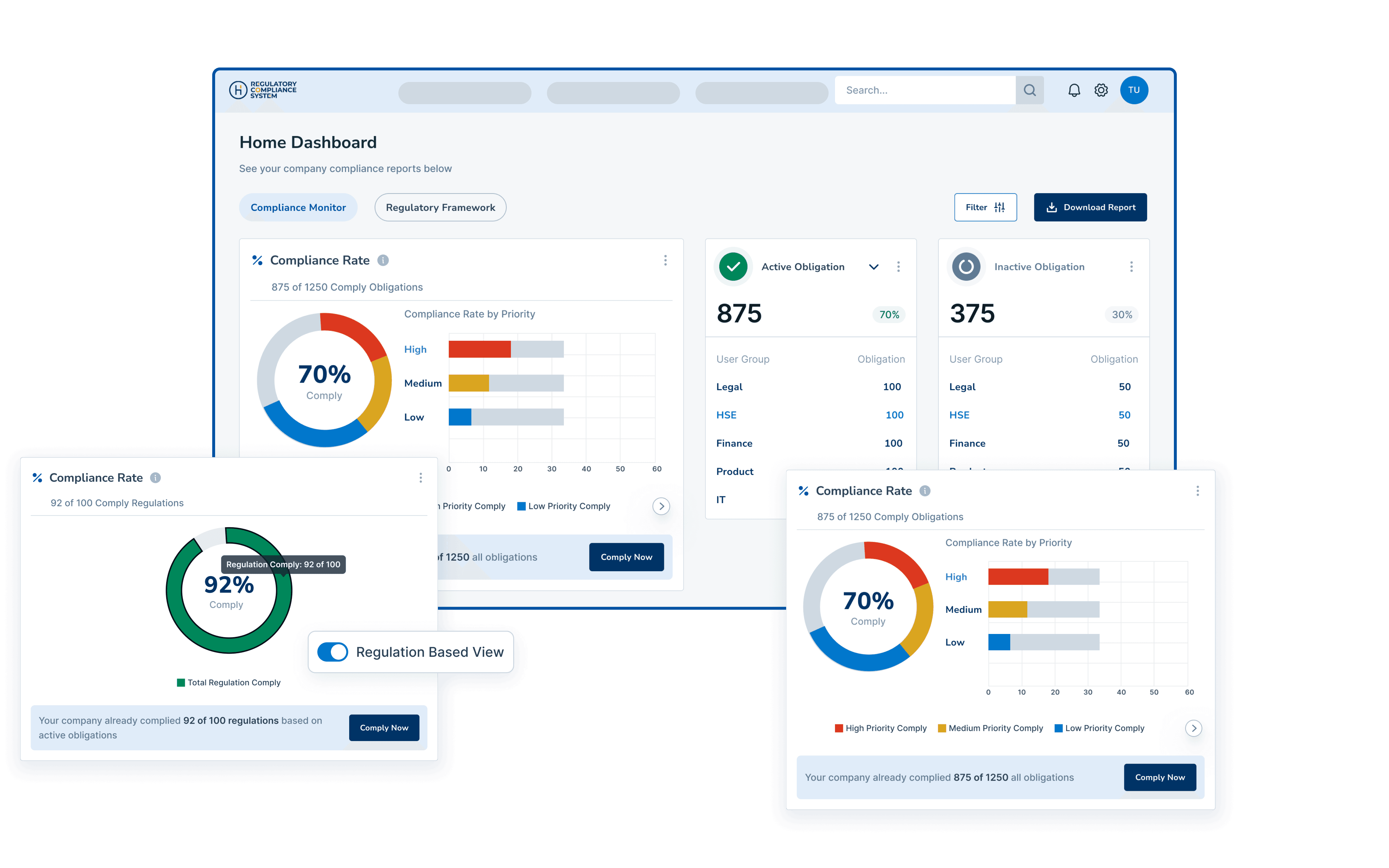
With the advantages offered by NEX Compliance, business actors no longer need to worry about failing to meet legal standards and/or legal risks from the non-fulfillment of obligations or applicable statutory regulations.
Click here to get a free trial.

Harmed Reputation to Imposition of Criminal Sanctions, the Difficulties for Financial Service Institutions to Comply with Anti-Money Laundering, Prevention of Terrorism Financing, as well as Corruption, Collusion and Nepotism Regulations in Indonesia
MoreWe understand your business and challenges.
Find the best solution for your company's legal compliance now.